

Aces of Valor
$60.00
$78.00


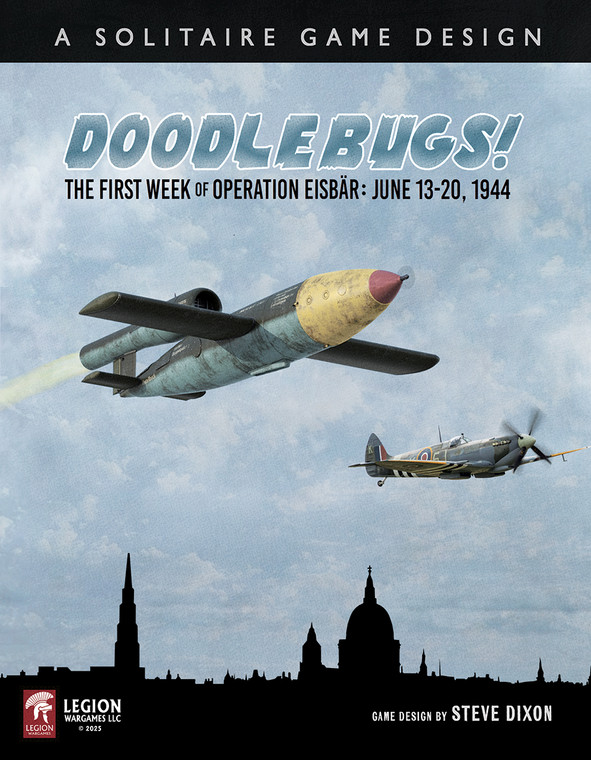
DOODLEBUGS!: The First Week of Operation Eisbär, 1944
A Solitaire Game Design by Steve Dixon
DOODLEBUGS! is a solitaire game in which the player controls the British response to the V-1 rocket launches of Flak Regiment 155 located along the coast of France across the channel. Their target...London!
The game covers the first week of Operation Eisbär, which began on June 13, 1944. The game concludes after the last phase of the game is completed for June 20. The actual campaign continued until March 1945. The goal of the player (playing the British side) is to prevent the Germans from gaining a victory, which would bring a tremendous propaganda coup for Nazi Germany.
Operation Eisbär started in full force on June 13. The Germans did launch V-1’s on 12 June but none made it to England, hence the game’s start date of June 13. Firings continued until Oct. 1944. Of the 5,823 V-1’s launched during the first month (until July 15) 2242 hit London. Aircraft were responsible for shooting down 925, AA 261, and the barrage balloons were responsible for 55 V-1 losses.
At its peak, more than one hundred V-1s a day were fired at southeast England, 9,521 in total, decreasing in number as sites were overrun until October 1944, when the last V-1 site in range of Britain was overrun by Allied forces. After this, the Germans directed V-1s at the port of Antwerp and at other targets in Belgium, launching a further 2,448 V-1s. The attacks stopped only a month before the war in Europe ended, when the last launch site in the Low Countries was overrun on 29 March 1945.
The aircraft in the game, while fast, could barely keep up with the V-1 making it difficult to sustain attacks against it, hence fighters can only fire once. Close range was preferred but it had its risks.
“We found the ideal tactics for destroying the menacing missiles to be crucially governed by the range at which we fired. Rounds shot from 250 yards or more usually hit the flying control system of the craft, which would then dive into the ground still with an active warhead. Opening fire from a range of 150 yards of less almost always clobbered the warhead which could severely damage the attacking fighter when it exploded. The best chances for success came when shooting between 200 and 250 yards, as from this distance you were reasonably certain of exploding the warhead in the air without undue damage to your fighter…” wrote Wing Commander Bobby Oxspring.
The AA batteries did not have proximity fuses. Once these started to come in from the US in the following month, AA kills began to increase and would surpass aircraft kills as time went on.
By the date in the game, it was pretty clear the Germans were going to lose the war. It was just a matter of when. What could have happened if the Germans were successful with Operation Eisbär was to see the Churchill government resign. If this had happened it would have been a tremendous propaganda victory for the Germans. But it would not have won the war for them.
The V-1 had several nicknames, the English called it a Doodlebug while the US called it a Buzz Bomb. The Germans may have called it a Höllenhund (hell hound), Kirschkern (cherry stone), or Maikäfer (maybug). V was short for Vergeltungswaffen (vengeance weapon). Its official Reich Aviation Ministry (RLM) designation was Fieseler Fi 103.


Solid effort by Steve Dixon. I’d like to see more player agency in the defense of London, and more variation in the fire fighting phases, but the game is enjoyable as is and makes for a quick, satisfying session.
This is a great solo game. Usually, a game only takes about an hour or less. Each game is exciting and a nail biter. It can be very difficult to win. We'll done!
Doodlebugs! The first week of Operation Eisbar is a solitaire game designed by Steve Dixon and published by Legion Games. My first impression is that it’s a great-looking game. The map is unusual in that it’s 11’ x 25’ -ish map. It has all the necessary tables and turn sequence. There are spaces for about everything. Generally, the doodlebugs fly from the bottom of the map to the top. On the way there are opportunities for fighters to engage, AA and lastly flak and barrage balloons. Next comes London. A random number of V1s launch from each detachment. A random number of them fail, then the survivors land on London, randomly. There are two places where the player makes decisions. If there are fighters available the player can choose to intercept over water then again over land. Fighter placement occurs after the player knows how many V1s are coming and along which axis. I assume that knowledge comes from radar detection. Fighters can intercept at short, medium and long range. The chances of shooting-down V1s gets better the shorter the range but the chance of loosing fighters (getting knocked down or damaged by the exploding V1) increases. It seems to me that if there’s a large number of V1’s coming it makes the best sense to intercept them early, over water. That’s part of the fun. The next decision the player makes is allocating firefighting resources to battle the fires started by the V1s. It’s pretty simple but critical to winning the game. Fires get started by every V1 that lands on London and, of course, they land randomly. Each hit adds a fire chit to that sector. The firefighters put them out, more so the more firefighters you can shift the the burning sectors. If a sector accumulates more fire chits than there are firefighters the fire is considered out of control and counts against the player’s chance of winning the game. Winning is determined by how many out-of-control fires and lost fighters there are at the end of the game. Every two lost fighters count as an out-of-control fire. So, the game’s tension is driven by the risks you take with your fighters and how good you firefighters are at putting out fires. Likable details: The fighters are shown by type and squadron. The V-1’s are launched by their historical detachments. London looks like London. The game turn track includes the reinforcement schedule. Things I don’t like: Not many. The designer has been quick to answer questions and there’s errata to cover any gray areas that I’ve found. The player is truly up against a lot of random factors. But I guess that’s the truth of it. It’s a fun game on an obscure subject.
Fun Game
This is a great, quick game that sets up fast. It can play quickly, but forces you to make crucial decision quickly. Each game is always different from the last game you played. The game is a frustrating challenge, just like real war. Skill and experience with the game system are important, but don't always trump luck.
This solitaire game features few substantive decisions for the player to make; randomizing predominates.
Great price for a fun game!
An impressive first experience with Legion War Games. The components are top-tier, and the resource management is gripping. Balancing airpower interceptions with firefighting adds a great layer of tension. As someone long interested in WWII era V1 interceptions, I found the parallels to modern missile defense both fascinating and a bit frightening. History does indeed rhyme.